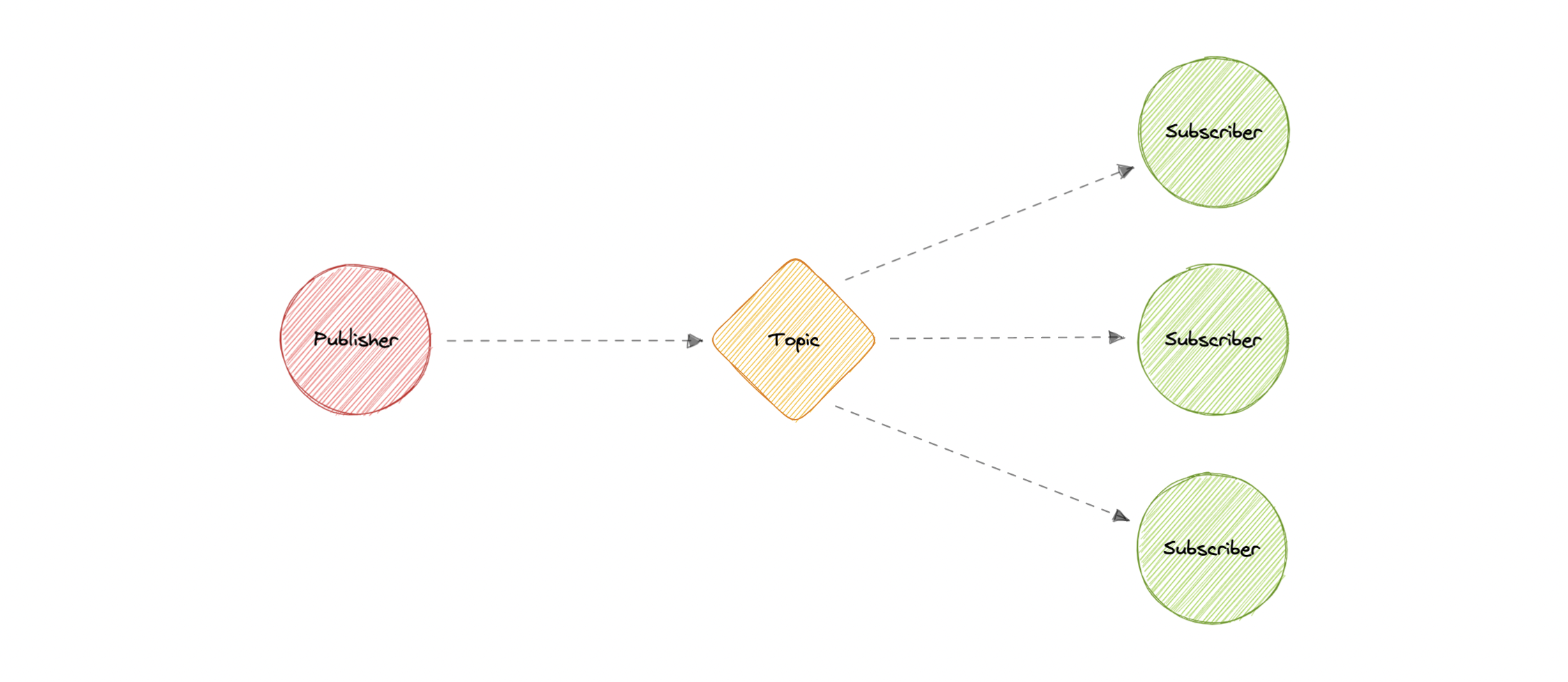
 The subscribers to the message topic often perform different functions, and can each do something different with the message in parallel. The publisher doesn’t need to know who is using the information that it is broadcasting, and the subscribers don’t need to know where the message comes from. This style of messaging is a bit different than message queues, where the component that sends the message often knows the destination it is sending to.
Working
Unlike message queues, which batch messages until they are retrieved, message topics transfer messages with little or no queuing and push them out immediately to all subscribers. Here’s how it works:- A message topic provides a lightweight mechanism to broadcast asynchronous event notifications and endpoints that allow software components to connect to the topic in order to send and receive those messages.
- To broadcast a message, a component called a publisher simply pushes a message to the topic.
- All components that subscribe to the topic (known as subscribers) will receive every message that was broadcasted.
Advantages
Let’s discuss some advantages of using publish-subscribe:- Eliminate Polling: Message topics allow instantaneous, push-based delivery, eliminating the need for message consumers to periodically check or “poll” for new information and updates. This promotes faster response time and reduces the delivery latency which can be particularly problematic in systems where delays cannot be tolerated.
- Dynamic Targeting: Pub/Sub makes the discovery of services easier, more natural, and less error-prone. Instead of maintaining a roster of peers where an application can send messages, a publisher will simply post messages to a topic. Then, any interested party will subscribe its endpoint to the topic, and start receiving these messages. Subscribers can change, upgrade, multiply or disappear and the system dynamically adjusts.
- Decoupled and Independent Scaling: Publishers and subscribers are decoupled and work independently from each other, which allows us to develop and scale them independently.
- Simplify Communication: The Publish-Subscribe model reduces complexity by removing all the point-to-point connections with a single connection to a message topic, which will manage subscriptions and decide what messages should be delivered to which endpoints.